Internal Control · 2025
In this section10 topics
- Internal Control — Board Opinion2 items
- Adequacy & Appropriateness of the Internal Control System1 item
- Internal Control Deficiencies2 items
- Audit Committee & Auditor Observations3 items
- Opinion on the Head of Internal Audit2 items
- Appointment, Discharge & Transfer of the Head of Internal Audit2 items
- Related Party Transactions2 items
- Counterparties & Transactions3 items
- Policy & Future Trends2 items
- Appraised Assets & Appraisal Prices1 item
Internal Control — Board Opinion
Introduction
The Company implements internal controls in accordance with the international standard framework of The Committee of Sponsoring Organizations of the Treadway Commission (COSO) to achieve the three objectives of internal control, namely:
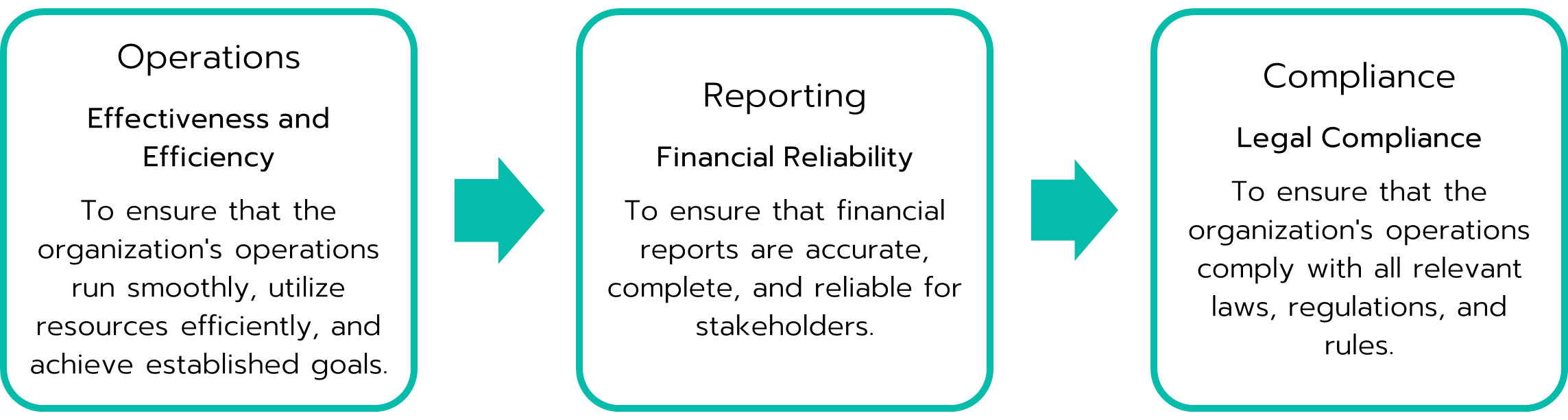
The Board of Directors places importance on the system of operational process controls established jointly by management and personnel within the departments to provide reasonable assurance that management is efficient, effective, and reduces losses from business operations under constantly changing conditions. This also includes overseeing business operations to align with goals, objectives, and relevant laws and regulations efficiently, and establishing an anti-corruption policy communicated to all levels of employees for strict adherence, with regular reviews and reporting of audit results.
Summary of the Board's Opinion on Internal Control
At the Board of Directors meeting No. 1/2568 on February 27, 2568, independent directors and audit committee members were present and considered and acknowledged the results of the Company's internal control system assessment, presented by the Head of Internal Audit. This assessment considered the Company's internal control system based on the five key components according to the guidelines of The Committee of Sponsoring Organizations of the Treadway Commission ("COSO").
The Company's internal control components comply with the international standards of The Committee of Sponsoring Organizations of the Treadway Commission (COSO), which include the control environment, risk assessment, control activities, information and communication systems, and monitoring activities. The Audit Committee and the Board of Directors are of the opinion that the Company has an adequate internal control system. The Company has provided sufficient personnel to operate the system efficiently, and also has processes for monitoring and overseeing the operations of the Company and its subsidiaries.
The Company operates its internal control system under all five components of the COSO internal control framework, with an overview of operations as follows:
1. Control Environment.
The Company establishes a control environment that is appropriate and sufficient for business operations by defining charters, policies, and an administrative structure suitable for the business environment. It fosters an organizational culture that emphasizes adherence to good corporate governance and business ethics within the Company Group, as well as the Company's internal control culture, with the Board of Directors and executives setting good examples and managing in accordance with the internal control framework.
|
Adherence to the values of integrity and ethics. |
The Company has documented its Good Corporate Governance and Code of Conduct. Directors, executives, and employees at all levels must sign to acknowledge and strictly adhere to the Good Corporate Governance Handbook and the Code of Conduct. Conflicts of interest are reported annually or immediately upon occurrence. There is a process for monitoring and evaluating compliance with various rules and regulations. An independent external internal audit unit (Dhammaniti Internal Audit Co., Ltd.) has been appointed. Operational procedures and control of operations are defined to ensure employees adhere to the Company's business ethics, including upholding integrity and ethics. |
|
Independence and oversight function, and development of internal control operations. |
The Company clearly defines the scope, authority, and responsibilities of the Board of Directors to be independent and separate from management. The Board of Directors is responsible for overseeing the operational direction, setting the Company's annual goals, plans, and budget, and regularly monitoring the performance of management to ensure that management achieves the Company's strategic plans and objectives in accordance with established policies. The Audit Committee oversees and provides opinions on internal audits, financial reports, and the results of the internal control system's adequacy assessment. The Audit Committee is responsible for overseeing the development and implementation of the Company's internal controls to be efficient, adequate, and appropriate. The Audit Committee members possess knowledge, abilities, and experience from various professions beneficial to the Company's business operations, are independent from management, can perform their duties effectively, and meet the qualifications that do not conflict with the Public Limited Company Act B.E. 2535, the regulations of the Stock Exchange of Thailand and the Securities and Exchange Commission, or other relevant laws, including the Company's articles of association. To oversee important processes, the Board of Directors has established sub-committees in accordance with good governance principles, namely the Nomination and Remuneration Committee, the Audit Committee, and the Risk Management Committee. All sub-committees have strictly performed their duties according to their respective charters and reported their operations to the Board of Directors. |
|
Appropriate reporting line structure, approval authority, and responsibilities. |
The Company defines its organizational structure, chain of command, job positions, and staffing levels in line with current circumstances and to support the achievement of the Company's objectives. Appropriate internal controls are established, with key duties segregated to create a system of checks and balances. The Company defines the scope of duties and responsibilities for the Board of Directors and various sub-committees in each committee's charter. Job responsibilities are defined in Job Description Forms for all positions, with employees signing to acknowledge their duties. Additionally, approval authorities for operations and financial limits are specified in the "Company's Authority Manual." |
|
Committed to motivating, developing, and retaining knowledgeable and capable personnel. |
The Company defines operational procedures for employees, conducts annual performance evaluations for consideration in promotions, salary adjustments, and bonus payments, and provides welfare benefits in accordance with the law. The Company develops employees through on-the-job training by supervisors within departments and has a continuous personnel development plan by regularly providing training to enhance employees' knowledge, thereby promoting and developing employees to be more efficient, in line with the succession plan, to respond to the vision, mission, and align with the organization's future direction. |
|
Human resource management to achieve the Company's objectives. |
The Company establishes clear and fair performance evaluation criteria, using Key Performance Indicators (KPIs) that align with the business plan or operational plan of each department. Performance of each department is monitored through monthly meetings with executives to report results. If performance does not meet the set targets, a joint inquiry and analysis of causes will be conducted to find improvement/correction approaches to achieve common goals, without creating excessive pressure on employees at all levels. |
2. Risk Assessment.
Risk management is a tool that supports the achievement of business objectives. The Company conducts risk management according to the COSO-ERM Framework 2017, aiming for enterprise-wide risk management, as detailed below:
|
Clear definition of organizational goals and objectives. |
The Board of Directors has appointed a Risk Management Committee to be responsible for risk management and to consider and provide opinions on policies, strategies, and approaches for risk governance, covering various important types of risks related to the Company's business operations, as well as appropriately defining risk levels and key risk indicators. The Risk Management Working Group will report risk management results to the Risk Management Committee quarterly. The Company prepares financial reports showing operating results and cash flow, accurately in accordance with financial reporting standards and the auditor's opinion. |
|
Comprehensive risk identification and analysis. |
The Company considers risks from both internal and external factors, categorized into various aspects related to the Company. It identifies and analyzes all types of risks that may impact business operations to comprehensively achieve objectives across the entire organization, considering levels from the organizational level, business units, departments, and various sections. Risk management is considered a crucial component of all business processes and must be interconnected at all levels, including identifying existing controls and additional controls to reduce the severity and likelihood of events to an acceptable risk level (Risk Appetite). An Enterprise Risk Management Committee, a sub-committee, has been established to oversee and support the implementation of enterprise risk management in alignment with business strategies and goals, as well as changing circumstances, and to provide recommendations, monitor, and evaluate to ensure the highest effectiveness of overall risk management. |
|
The Board of Directors has established an Audit Committee to promote good corporate governance within the Company. Its role is to review the adequacy of the internal control system. A corporate governance manual has been prepared, including policies such as the Conflict of Interest Policy and the Anti-Corruption Policy. Penalties for violations are stipulated in the work regulations. |
|
|
Identification and assessment of changes that may affect the internal control system. |
The Company emphasizes assessing potential risks that may arise when there are changes in organizational leadership or personnel in key positions. Therefore, it establishes a succession planning policy, develops the potential of executives, and provides specialized development in the career paths of each department. |
3. Control Activities.
The Board believes that the Company has clearly defined the scope of authority, detailed approval levels, and strictly separated responsibilities for approval, accounting records, and information, all for mutual verification.
|
Internal control measures that manage risks to an acceptable level. |
The Company has established written internal control measures for operations in each process, covering important processes throughout the organization. These measures are communicated, monitored, and reported to ensure that internal control measures are implemented effectively. The internal control system is designed and documented as an operational manual, ensuring compliance with operational steps and methods, combining both manual and automated approaches. Automated control measures are defined in various important processes under the operation of the ERP for Construction program via the Mango system. |
|
Develop general control activities with technology systems. |
The Company regularly reviews, improves, and designs the use of information technology in operations, consistent with the risk level of each process. For example, it designates information technology system administrators, installs technology system device management programs in all systems, and controls access to operating systems under advanced and secure authentication. The Company assigns the Information Technology Department responsibility for appropriately controlling the security of information technology systems, monitoring developments and new cyber threats in both project work systems and offices, educating all Company employees, and conducting security standard tests for various systems. |
|
Internal control through policy implementation. |
The Company has documented important organizational-level policies and practices, including the Company's Director's Handbook and various key policies such as the Internal Control Policy, Risk Management Policy, Anti-Corruption Policy, Policy on Receiving and Giving Gifts, Assets, or Other Benefits of the Company, and the Policy on Compliance with Laws and Regulations of the Company. The Company has considered transactions that meet the criteria for related party transactions to comply with the requirements of the Stock Exchange of Thailand, taking into account reasonableness and maximum benefit to the Company, and stipulates that transactions must be approved by authorized persons who must not have a conflict of interest. Furthermore, the Company has communicated important company-level policies to its directors, executives, and employees, and regularly monitors and assesses their understanding of these policies. |
4. Information & Communication Systems.
The Company continuously develops its information systems and data systems by providing efficient, effective, complete, and accurate data systems and communication channels, both internal and external to the organization.
|
Information quality management. |
The Company prepares Work Instructions (WI) as operational procedures for Construction Project Management, Construction Work Control, Approval of Construction Materials and Equipment, Procurement/Sourcing of Construction Materials and Equipment, and Project Budget Control. These are reviewed and approved by the executives of each department. The Company has implemented the Mango system to control construction project budgets. |
|
Internal organizational communication. |
The Company defines internal communication processes through various channels as designed by the Company to ensure that internal communication for important organizational information, critical operational information, and internal controls is reliable, secure, and efficient. The Company has designated channels for receiving information, complaints, or tips regarding fraud or corruption, either via postal mail or email. The Company will maintain utmost confidentiality for the safety of the complainant. |
|
Communication with external agencies. |
The Company focuses on disclosing information to external agencies and all stakeholder groups to ensure that published information is accurate, complete, transparent, and timely, covering both financial and non-financial data. The Corporate Communications department is responsible for communicating disclosable information to stakeholders and external agencies, while the Investor Relations department is responsible for providing financial and important Company information to shareholders and investors. Furthermore, the Company has established communication channels via electronic mail, the Company's website, and the Company's annual report, through which external parties can register to receive news and activities of the Company, retrieve Company information, and report corruption through secure and confidential channels as designated by the Company. |
5. Monitoring Activities.
The Company has processes for monitoring and evaluating the adequacy of its internal control system, as well as continuously developing and improving the Company's internal control system to be efficient and appropriate for the evolving control environment.
|
Monitoring and evaluation of the internal control system. |
There are processes for monitoring compliance with business ethics and regulations prohibiting management and Employees conduct themselves in a manner that may give rise to conflicts of interest, with the Corporate Governance Department continuously monitoring, overseeing, and evaluating compliance with the code of conduct annually, and reporting to the Good Corporate Governance and Sustainable Development Committee. The internal audit unit also inspects work processes according to the annual audit plan. Should any unusual items or significant deficiencies be found, a report with recommendations will be submitted to the Audit Committee and the Chief Executive Officer. Furthermore, Control Self-Assessment is conducted at both the executive and process levels to build confidence among stakeholders. |
|
Timely and appropriate assessment and communication of internal control deficiencies. |
In cases where areas for improvement are identified, procedures are established to ensure that audit and review findings are promptly addressed and reported to the Audit Committee. Should any illegal practices or unusual actions that could significantly impact the Company's reputation and financial standing be discovered, the internal audit unit will report the issues, deficiencies, proposed solutions, and progress to the Internal Audit Committee for onward reporting to the Board of Directors. |
Adequacy & Appropriateness of the Internal Control System
Internal Control Framework Used
| Framework | Detail | ||||
|---|---|---|---|---|---|
| The Committee of Sponsoring Organizations of the Treadway Commission (COSO) | The Company has an internal control system covering the scope, authority, duties, and responsibilities of the Board of Directors, sub-committees, Chief Executive Officer, and Managing Director in writing. They are responsible for overseeing the operational direction and goals of the organization, regularly monitoring the performance of management to ensure that management operates in accordance with the Company's strategic plans and goals, and in line with established policies. The Audit Committee is responsible for overseeing and providing opinions on internal audits, financial reports, and the results of the assessment of the adequacy of the Company's internal control system. The Company defines its organizational structure, lines of command, job positions, and staffing levels. Human resource management policies are established to align HR management direction with the Company's strategies and goals. These HR policies support mutual sustainable success and progress between employees and the organization. This includes defining HR management strategies, critical succession planning, recruitment, and preparing high-potential executives for business continuity. Monitoring and evaluating the internal control system is part of good corporate governance. The Legal and Corporate Regulations Department is responsible for collecting and monitoring laws related to the Company's operations, establishing procedures for compliance with relevant laws and regulations, and supervising and monitoring to ensure that all employees understand and strictly adhere to relevant laws and regulations. Furthermore, operational monitoring and control can prevent the Company's or its subsidiaries' assets from being misused or unauthorizedly used by directors or executives. For other internal control topics, the Board of Directors believes that the Company also has adequate internal controls. Furthermore, the Company's auditor is D.I.A. International Audit Co., Ltd., represented by Dr. Kamonmat Krittayakiart, Certified Public Accountant Registration No. 10435, who audited the quarterly financial statements and the annual financial statements for 2025, and did not express any opinion in the audit report indicating deficiencies in the Company's internal control system. In 2025, the Company carried out significant operational monitoring, control, and evaluation, which included:
|


Internal Control Deficiencies
Introduction
The objective of an effective audit system is not merely to identify control deficiencies but also to ensure that identified issues are resolved efficiently and promptly. The process of identifying deficiencies involves audit findings, performance reviews, exception reports, user feedback, and an assessment of the severity and risk of each deficiency. Once deficiencies are identified and categorized,
Therefore, management planned and implemented corrective actions by assigning clear responsibilities, procedures, resource allocation, and timelines. Delays in remediation could lead to regulatory violations, fraud, or reputational damage. Furthermore, after implementing the corrective action plan, retesting controls and updating policies and procedures as appropriate are crucial.
In 2025, the Company addressed significant deficiencies related to internal controls, monitored and controlled operations until successful completion, and reported the results to management as follows:
|
|
1. Internal Control Database System. The Company has specifically developed an information technology system to serve as the primary database for operational risks and internal controls, ensuring its security and reliability. |
|
|
2. Raising awareness and understanding of internal controls. The Company conducted continuous training and communication throughout the year, and assessed the awareness and understanding levels of employees at all levels across the organization, achieving the set targets. |


Number of Deficiencies
| Metric | Current Year | Previous Year | Two Years Ago |
|---|---|---|---|
| Total number of internal control system deficiencies (cases) | 0 | 0 | 0 |
Audit Committee & Auditor Observations
Audit Committee's Opinion Differs from the Board's
Yes
Audit Committee's Differing Opinion
Does the Audit Committee have a different opinion regarding internal controls from the Board of Directors? : No.
Does the auditor have any observations regarding the company's internal controls? : There are observations
Internal audit no. 4/2568 regarding operational performance ESG by the company's working group.
There are 2 recommendations currently in progress, as follows:
-
Engaging a verifier registered with the Greenhouse Gas Management Organization to verify the company's greenhouse gas emission calculation results.
-
Setting annual greenhouse gas emission reduction targets to achieve the defined Carbon Neutrality and Net Zero goals.
Auditor Has Observations on Internal Control
No
Opinion on the Head of Internal Audit
Head of Internal Audit
3160
Audit Committee's Opinion on the Head of Internal Audit
Internal Coordinator for the Company's Internal Control System Audit
Head of Internal Audit: An internal personnel of the company.
From the 35/2021 Board of Directors' Meeting held on October 22, 2021, a resolution was passed to approve the appointment of Ms. Pakamon Chanhom as the Internal Control System Audit Coordinator. Her duties include evaluating internal controls, providing impartial advice, and overseeing the operations of the Internal Audit Department to ensure they align with objectives and international standards, reporting directly to the Audit Committee.
In 2025, the following duties were performed:
• Propose the annual audit plan for 2025 to the Audit Committee for consideration and approval.
• Oversee the performance of internal auditors and review their work to ensure compliance with standards.
• Provide consultation and advice to ensure compliance with regulations, orders, and internal controls for the audited units.
• Audit expense disbursement controls, asset safeguarding, systematic document storage, and oversee the unit's operations to ensure adherence to the established work plan, including clearly defining employee responsibilities.
Appointment, Discharge & Transfer of the Head of Internal Audit
Requires Audit Committee Approval
Yes
Description
Is the appointment, removal, and transfer of the Head of Internal Audit subject to the approval of the Audit Committee? : Yes
Refers to the Audit Committee Charter, which specifies the scope, duties, and responsibilities of the Audit Committee in considering the appointment, transfer, termination, and annual performance evaluation of the Chief Audit Executive.
The internal audit plan for 2025 is as follows:
1/2568 Topic Information Technology and Cyber Security ( ITGCs)
2/2568 Topic Project Proposal Cost Estimation
3/2568 Topic Project Management and Safety Control in Construction Work
4/2568 Topic Operational aspects of ESG
Related Party Transactions
Has Related Party Transactions
Yes
Related Party Transactions Link
https://www.well-graded.com/investor/financial-analysis
Counterparties & Transactions
Monetary Unit
1000000
Counterparties with Potential Conflicts
| Name | Person / Juristic Person | Type of Business | Nature of Relationship | As of Date (YYYY-MM-DD) |
|---|---|---|---|---|
| Well Grade Engineering and Construction Company Limited | Juristic Person | Engaged in construction contracting business | is a major shareholder with a 100.00% stake and has common directors, namely Mr. Kriangsak Buanum, Mr. Wayu Thongpoon, and Ms. Pakamon Chanhom. | 2025-12-31T00:00 |
| CC-WGE Joint Venture | Juristic Person | Engaged in the construction contracting business, having entered into a construction contract with the Department of Highways for the construction of a bridge over a railway crossing on the Huai Sai – Pak Phayun route in Phatthalung Province. | The investment proportions are as follows:
| 2025-12-31T00:00 |
| UEC-WGE Joint Venture | Juristic Person | Engaged in the construction contracting business, having entered into a construction contract with the Department of Highways for the construction of U-turn bridges (inbound and outbound) on Highway No. 1 in the vicinity of Ban Chamaeb, Phra Nakhon Si Ayutthaya Province. | The investment proportions are as follows:
| 2025-12-31T00:00 |
| WP Joint Venture | Juristic Person | Engaged in the construction contracting business, having entered into a construction contract with the Industrial Estate Authority of Thailand for the improvement of flood protection and drainage systems at Nakhon Luang Industrial Estate, Phra Nakhon Si Ayutthaya Province. | Investment proportions are as follows:
| 2025-12-31T00:00 |
| Central Park Land Company Limited (“CPL”) | Juristic Person | Engaged in real estate development business | There are 5 shareholders and directors collectively.
| 2025-12-31T00:00 |
| Studio Metal Solution Company Limited ("STO") | Juristic Person | Established on September 19, 2025, operating a business providing architectural metalwork services. | is a major shareholder with a 100.00% stake and has common directors, namely Mr. Kriangsak Buanum, Mrs. Ploypatcha Buanum, Mr. Kriangkrai Buanum, and Ms. Pakamon Chanhom. | 2025-12-31T00:00 |
Transactions by Counterparty
| Transactions |
|---|
| 0.0 · Necessity: It is a normal business transaction · Description: The Company undertakes construction contracts for WGEC and engages WGEC's workforce through mutual agreements. · As of yesteryear: 0.0 · Nature of transaction: Revenue from construction contracts · Audit committee opinion: Intercompany transactions under general trading conditions, which received approval in principle from the Audit Committee Meeting No. 1/2569 on February 19, 2569. · As of year before yesteryear: 7.1 · 0.05 · Necessity: It is a normal business transaction · Description: The Company undertakes construction contracts for WGEC and engages WGEC's workforce through mutual agreements. · As of yesteryear: 0.0 · Nature of transaction: Other Income - Service Fees · Audit committee opinion: Intercompany transactions under general trading conditions, which received approval in principle from the Audit Committee Meeting No. 1/2569 on February 19, 2569. · As of year before yesteryear: 0.0 · 9.98 · Necessity: It is a normal business transaction · Description: The Company undertakes construction contracts for WGEC and engages WGEC's workforce through mutual agreements. · As of yesteryear: 0.0 · Nature of transaction: Subcontracting fees · Audit committee opinion: Intercompany transactions under general trading conditions, which received approval in principle from the Audit Committee Meeting No. 1/2569 on February 19, 2569. · As of year before yesteryear: 0.0 · 0.0 · Necessity: It is a normal business transaction · Description: The Company undertakes construction contracts for WGEC and engages WGEC's workforce through mutual agreements. · As of yesteryear: 0.09 · Nature of transaction: Interest Expense · Audit committee opinion: Intercompany transactions under general trading conditions, which received approval in principle from the Audit Committee Meeting No. 1/2569 on February 19, 2569. · As of year before yesteryear: 0.0 · 0.06 · Necessity: It is a normal business transaction · Description: The Company undertakes construction contracts for WGEC and engages WGEC's workforce through mutual agreements. · As of yesteryear: 0.0 · Nature of transaction: Other Current Receivables · Audit committee opinion: Intercompany transactions under general trading conditions, which received approval in principle from the Audit Committee Meeting No. 1/2569 on February 19, 2569. · As of year before yesteryear: 0.0 · 1.82 · Necessity: It is a normal business transaction · Description: The Company undertakes construction contracts for WGEC and engages WGEC's workforce through mutual agreements. · As of yesteryear: 0.0 · Nature of transaction: Trade Creditors · Audit committee opinion: Intercompany transactions under general trading conditions, which received approval in principle from the Audit Committee Meeting No. 1/2569 on February 19, 2569. · As of year before yesteryear: 0.0 · 0.38 · Necessity: It is a normal business transaction · Description: The Company undertakes construction contracts for WGEC and engages WGEC's workforce through mutual agreements. · As of yesteryear: 0.0 · Nature of transaction: Beneficiary of Performance Guarantee · Audit committee opinion: Intercompany transactions under general trading conditions, which received approval in principle from the Audit Committee Meeting No. 1/2569 on February 19, 2569. · As of year before yesteryear: 0.0 |
| 0.0 · Necessity: It is a normal business transaction · Description: The Company entered into a contract for the construction of a bridge over a railway crossing. · As of yesteryear: 8.31 · Nature of transaction: Revenue from Sales of Materials and Equipment · Audit committee opinion: Intercompany transactions under general trading conditions, which received approval in principle from the Audit Committee Meeting No. 1/2569 on February 19, 2569. · As of year before yesteryear: 0.0 · 0.0 · Necessity: It is a normal business transaction · Description: The Company entered into a contract for the construction of a bridge over a railway crossing. · As of yesteryear: 8.42 · Nature of transaction: Other Income - Service Fees · Audit committee opinion: Intercompany transactions under general trading conditions, which received approval in principle from the Audit Committee Meeting No. 1/2569 on February 19, 2569. · As of year before yesteryear: 6.88 · 0.0 · Necessity: It is a normal business transaction · Description: The Company entered into a contract for the construction of a bridge over a railway crossing. · As of yesteryear: 4.09 · Nature of transaction: Other Income - Rental Income · Audit committee opinion: Intercompany transactions under general trading conditions, which received approval in principle from the Audit Committee Meeting No. 1/2569 on February 19, 2569. · As of year before yesteryear: 4.01 · 2.62 · Necessity: It is a normal business transaction · Description: The Company entered into a contract for the construction of a bridge over a railway crossing. · As of yesteryear: 4.84 · Nature of transaction: Financial Income · Audit committee opinion: Intercompany transactions under general trading conditions, which received approval in principle from the Audit Committee Meeting No. 1/2569 on February 19, 2569. · As of year before yesteryear: 1.47 · 0.25 · Necessity: It is a normal business transaction · Description: The Company entered into a contract for the construction of a bridge over a railway crossing. · As of yesteryear: 1.97 · Nature of transaction: Purchase equipment · Audit committee opinion: Intercompany transactions under general trading conditions, which received approval in principle from the Audit Committee Meeting No. 1/2569 on February 19, 2569. · As of year before yesteryear: 0.0 · 28.05 · Necessity: It is a normal business transaction · Description: The Company entered into a contract for the construction of a bridge over a railway crossing. · As of yesteryear: 28.68 · Nature of transaction: Other Current Receivables · Audit committee opinion: Intercompany transactions under general trading conditions, which received approval in principle from the Audit Committee Meeting No. 1/2569 on February 19, 2569. · As of year before yesteryear: 8.52 · 6.45 · Necessity: It is a normal business transaction · Description: The Company entered into a contract for the construction of a bridge over a railway crossing. · As of yesteryear: 3.83 · Nature of transaction: Accrued Interest · Audit committee opinion: Intercompany transactions under general trading conditions, which received approval in principle from the Audit Committee Meeting No. 1/2569 on February 19, 2569. · As of year before yesteryear: 1.01 · 69.5 · Necessity: It is a normal business transaction · Description: The Company entered into a contract for the construction of a bridge over a railway crossing. · As of yesteryear: 69.5 · Nature of transaction: Short-term loans · Audit committee opinion: Intercompany transactions under general trading conditions, which received approval in principle from the Audit Committee Meeting No. 1/2569 on February 19, 2569. · As of year before yesteryear: 47.0 · 1.43 · Necessity: It is a normal business transaction · Description: The Company entered into a contract for the construction of a bridge over a railway crossing. · As of yesteryear: 1.43 · Nature of transaction: Sales tax not yet due · Audit committee opinion: Intercompany transactions under general trading conditions, which received approval in principle from the Audit Committee Meeting No. 1/2569 on February 19, 2569. · As of year before yesteryear: 0.56 · 8.98 · Necessity: It is a normal business transaction · Description: The Company entered into a contract for the construction of a bridge over a railway crossing. · As of yesteryear: 99.88 · Nature of transaction: List of Guaranteed Liabilities, Credit Limit, Kasikornbank · Audit committee opinion: Intercompany transactions under general trading conditions, which received approval in principle from the Audit Committee Meeting No. 1/2569 on February 19, 2569. · As of year before yesteryear: 99.88 |
| 0.0 · Necessity: It is a normal business transaction · Description: The Company entered into a contract for the construction of an inbound and outbound U-turn bridge. · As of yesteryear: 14.72 · Nature of transaction: Revenue from Sales of Materials and Equipment · Audit committee opinion: Intercompany transactions under general trading conditions, which received approval in principle from the Audit Committee Meeting No. 1/2569 on February 19, 2569. · As of year before yesteryear: 1.36 · 0.38 · Necessity: It is a normal business transaction · Description: The Company entered into a contract for the construction of an inbound and outbound U-turn bridge. · As of yesteryear: 11.09 · Nature of transaction: Other Income - Service Fees · Audit committee opinion: Intercompany transactions under general trading conditions, which received approval in principle from the Audit Committee Meeting No. 1/2569 on February 19, 2569. · As of year before yesteryear: 14.29 · 0.0 · Necessity: It is a normal business transaction · Description: The Company entered into a contract for the construction of an inbound and outbound U-turn bridge. · As of yesteryear: 5.48 · Nature of transaction: Other Income - Rental Income · Audit committee opinion: Intercompany transactions under general trading conditions, which received approval in principle from the Audit Committee Meeting No. 1/2569 on February 19, 2569. · As of year before yesteryear: 6.08 · 1.28 · Necessity: It is a normal business transaction · Description: The Company entered into a contract for the construction of an inbound and outbound U-turn bridge. · As of yesteryear: 2.06 · Nature of transaction: Financial Income · Audit committee opinion: Intercompany transactions under general trading conditions, which received approval in principle from the Audit Committee Meeting No. 1/2569 on February 19, 2569. · As of year before yesteryear: 0.0 · 0.29 · Necessity: It is a normal business transaction · Description: The Company entered into a contract for the construction of an inbound and outbound U-turn bridge. · As of yesteryear: 0.0 · Nature of transaction: Purchase equipment · Audit committee opinion: Intercompany transactions under general trading conditions, which received approval in principle from the Audit Committee Meeting No. 1/2569 on February 19, 2569. · As of year before yesteryear: 0.0 · 52.65 · Necessity: It is a normal business transaction · Description: The Company entered into a contract for the construction of an inbound and outbound U-turn bridge. · As of yesteryear: 53.63 · Nature of transaction: Other Current Receivables · Audit committee opinion: Intercompany transactions under general trading conditions, which received approval in principle from the Audit Committee Meeting No. 1/2569 on February 19, 2569. · As of year before yesteryear: 23.09 · 0.0 · Necessity: It is a normal business transaction · Description: The Company entered into a contract for the construction of an inbound and outbound U-turn bridge. · As of yesteryear: 2.06 · Nature of transaction: Accrued Interest · Audit committee opinion: Intercompany transactions under general trading conditions, which received approval in principle from the Audit Committee Meeting No. 1/2569 on February 19, 2569. · As of year before yesteryear: 0.0 · 0.0 · Necessity: It is a normal business transaction · Description: The Company entered into a contract for the construction of an inbound and outbound U-turn bridge. · As of yesteryear: 51.0 · Nature of transaction: Short-term loans · Audit committee opinion: Intercompany transactions under general trading conditions, which received approval in principle from the Audit Committee Meeting No. 1/2569 on February 19, 2569. · As of year before yesteryear: 2.0 · 2.6 · Necessity: It is a normal business transaction · Description: The Company entered into a contract for the construction of an inbound and outbound U-turn bridge. · As of yesteryear: 2.58 · Nature of transaction: Sales tax not yet due · Audit committee opinion: Intercompany transactions under general trading conditions, which received approval in principle from the Audit Committee Meeting No. 1/2569 on February 19, 2569. · As of year before yesteryear: 1.42 · 7.29 · Necessity: It is a normal business transaction · Description: The Company entered into a contract for the construction of an inbound and outbound U-turn bridge. · As of yesteryear: 157.35 · Nature of transaction: List of Guarantee Obligations, Credit Limit, Krungthai Bank · Audit committee opinion: Intercompany transactions under general trading conditions, which received approval in principle from the Audit Committee Meeting No. 1/2569 on February 19, 2569. · As of year before yesteryear: 157.35 |
| 0.0 · Necessity: It is a normal business transaction · Description: The Company entered into a construction contract for the improvement of flood protection and drainage systems. · As of yesteryear: 0.46 · Nature of transaction: Other Income - Service Fees · Audit committee opinion: Intercompany transactions under general trading conditions, which received approval in principle from the Audit Committee Meeting No. 1/2569 on February 19, 2569. · As of year before yesteryear: 3.18 · 0.0 · Necessity: It is a normal business transaction · Description: The Company entered into a construction contract for the improvement of flood protection and drainage systems. · As of yesteryear: 0.02 · Nature of transaction: Other Income - Rental Income · Audit committee opinion: Intercompany transactions under general trading conditions, which received approval in principle from the Audit Committee Meeting No. 1/2569 on February 19, 2569. · As of year before yesteryear: 1.38 · 0.19 · Necessity: It is a normal business transaction · Description: The Company entered into a construction contract for the improvement of flood protection and drainage systems. · As of yesteryear: 0.35 · Nature of transaction: Financial Income · Audit committee opinion: Intercompany transactions under general trading conditions, which received approval in principle from the Audit Committee Meeting No. 1/2569 on February 19, 2569. · As of year before yesteryear: 0.51 · 0.0 · Necessity: It is a normal business transaction · Description: The Company entered into a construction contract for the improvement of flood protection and drainage systems. · As of yesteryear: 0.0 · Nature of transaction: Purchase equipment · Audit committee opinion: Intercompany transactions under general trading conditions, which received approval in principle from the Audit Committee Meeting No. 1/2569 on February 19, 2569. · As of year before yesteryear: 0.07 · 0.0 · Necessity: It is a normal business transaction · Description: The Company entered into a construction contract for the improvement of flood protection and drainage systems. · As of yesteryear: 0.0 · Nature of transaction: Other Current Receivables · Audit committee opinion: Intercompany transactions under general trading conditions, which received approval in principle from the Audit Committee Meeting No. 1/2569 on February 19, 2569. · As of year before yesteryear: 0.21 · 0.58 · Necessity: It is a normal business transaction · Description: The Company entered into a construction contract for the improvement of flood protection and drainage systems. · As of yesteryear: 0.39 · Nature of transaction: Accrued Interest · Audit committee opinion: Intercompany transactions under general trading conditions, which received approval in principle from the Audit Committee Meeting No. 1/2569 on February 19, 2569. · As of year before yesteryear: 0.05 · 5.0 · Necessity: It is a normal business transaction · Description: The Company entered into a construction contract for the improvement of flood protection and drainage systems. · As of yesteryear: 5.0 · Nature of transaction: Short-term loans · Audit committee opinion: Intercompany transactions under general trading conditions, which received approval in principle from the Audit Committee Meeting No. 1/2569 on February 19, 2569. · As of year before yesteryear: 3.0 · 0.0 · Necessity: It is a normal business transaction · Description: The Company entered into a construction contract for the improvement of flood protection and drainage systems. · As of yesteryear: 0.0 · Nature of transaction: Sales tax not yet due · Audit committee opinion: Intercompany transactions under general trading conditions, which received approval in principle from the Audit Committee Meeting No. 1/2569 on February 19, 2569. · As of year before yesteryear: 0.01 · 12.79 · Necessity: It is a normal business transaction · Description: The Company entered into a construction contract for the improvement of flood protection and drainage systems. · As of yesteryear: 164.77 · Nature of transaction: List of Guaranteed Liabilities, Credit Limit, Kasikornbank · Audit committee opinion: Intercompany transactions under general trading conditions, which received approval in principle from the Audit Committee Meeting No. 1/2569 on February 19, 2569. · As of year before yesteryear: 164.77 |
Policy & Future Trends
Policy, Measures & Approval Process
Related party transactions are subject to the approval of the Board of Directors, which has been delegated approval authority in accordance with the company's regulations, and the disclosure of related party transactions is in accordance with the regulations of the Securities and Exchange Commission of Thailand.
Future Trends in Related Party Transactions
For future related party transactions, the pricing of purchases and sales shall be based on market prices and/or as specified in commercial contracts, treating them as transactions conducted with external parties (Fair and Arm’s Length Basis). However, the Company shall prioritize its maximum benefits. Furthermore, significant related party transactions must be considered and approved by the Board of Directors.
Appraised Assets & Appraisal Prices
Appraised Assets & Appraisal Prices — Introduction
Further details can be found in 1.2.2.4 Assets used in business operations, specifically regarding asset valuation items.