

MD&A · 2025
In this section4 topics
Overview of Operations
Overview of Operations
Business Overview
Well Grade Engineering Public Company Limited ("the Company") operates a business providing construction services for various types of buildings and structures, including utility system construction work as specified by clients. The scope of the Company's services covers construction management and control, procurement of raw materials and labor, and structural construction work ( Structural Engineering), Architectural Engineering, Structural Steelwork, Precast Concrete, Interior Design, Renovation, and After Service ("Well Care"). For building systems (Mechanical and Electrical – M&E), the Company engages experienced subcontractors for each system, such as electrical systems, plumbing systems, air conditioning systems, and telephone and communication systems. These works are closely supervised by the Company's engineers and team, who possess knowledge, expertise, and experience. The Company's main target customer groups include hospitals, office buildings, residential condominiums, industrial factories, and infrastructure projects for both public and private sectors. The Company has the capability to provide comprehensive services for all construction needs for various types of buildings and structures. Therefore, the Company's policy is to accept construction projects directly from project owners as a main contractor. However, if a construction contract includes certain works requiring specialized expertise, the Company will procure subcontractors with appropriate qualifications and capabilities to specifically provide those services, thereby mitigating risks arising from errors due to lack of specialized knowledge in certain areas. The Company's construction operations can be divided into three types:
-
Main Contractor The Company will directly bid for projects or negotiate directly with project owners. However, for large-scale construction projects or those requiring specialized expertise, the Company may engage specialized subcontractors to assist in the work. The selection process for subcontractors will be based on their credibility and past performance, and the Company has a policy not to rely exclusively on any single subcontractor.
-
Subcontractor ( Sub Contractor) The Company will undertake work from other contractors who have received projects directly from the project owner. In this approach, the Company will only consider accepting work from reputable main contractors with stable financial standing. However, the Company will choose to operate as a subcontractor only in cases where the work is large-scale or where the Company does not meet the minimum qualifications to be the main contractor, such as high-value government projects.
-
Joint Venture In some cases, the Company may engage in joint business operations with two or more individuals or entities, involving joint investment of capital, assets, labor, technology, or other resources under a joint venture agreement or contract to operate a business together. This type of operation typically occurs when the Company undertakes large-scale projects that require labor and technology for implementation. Upon completion of such projects, the joint venture is considered terminated.
Considering the revenue structure, construction work can be classified by type as follows:
1. Types of General Building Projects ( Building) categorized by type of work as follows:
-
Hospital Construction This involves the construction of large buildings, but with distinct differences from general building construction in terms of building engineering systems, which require specialized experience and techniques due to limitations imposed by hygiene standards. Examples include the construction of hospitals with sterile rooms, research rooms, and laboratories that require control over particulate matter and other environmental factors.
-
Construction of Department Stores or Community Malls This involves the construction of large buildings with open structural characteristics, but with construction areas separated by department or sales area as specified by the client, along with the installation of building engineering systems.
-
Real Estate Construction The Company provides construction services for both low-rise and high-rise real estate, including sales offices for projects. The Company's customer base primarily consists of condominium developers. The construction format is divided into residential areas, common areas, and project utility systems, as well as building engineering systems.
-
Office Building Construction This involves the construction of large buildings with areas and proportions separated according to their intended use, along with integrated building engineering systems.
2. Types of Industrial Factory and Warehouse Projects
-
Industrial Factory Projects This involves the construction of large low-rise buildings with usable areas not exceeding 3 stories, featuring open spaces and divided usable areas according to client requirements, along with integrated building engineering systems.
3. Types of Infrastructure Projects ( Infrastructure)
-
Infrastructure Projects This refers to physical structures that facilitate public convenience, focusing on benefiting the public, such as roads, water supply systems, electrical systems, drainage systems, and communication systems, most of which belong to the government. The Company provides services for road construction, civil engineering, and utility system construction as specified by clients.
Operating Results & Financial Condition
Operating Results & Profitability
Operating results according to the consolidated financial statements of the company and its subsidiaries in Year 256 8, the net profit was Baht 149.46 million, while for the same period in 2024, the company had a net profit of Baht 51.10 million, representing an increase in profit of Baht 98.36 million or 192.52%.
In 2025, the construction contracting business is showing signs of recovery. Driving factors include large-scale government infrastructure investments, particularly those related to the Eastern Economic Corridor, which will stimulate private sector construction investment to expand, such as industrial estates. Additionally, the gradual economic recovery will support residential and commercial real estate construction, which is expected to gradually recover as purchasing power improves in line with economic conditions and advancing infrastructure. The recovery of the tourism sector has led to investments in related construction projects, such as hotels and various facilities. The Group is confident that in 2026, projects currently under bidding and awaiting bids, especially residential, hotel, general building, high-rise, and large-scale building types, with a focus on residential real estate projects, are expected to provide the Group with Backlog continuously increasing
The company is highly committed to enhancing its construction processes, incorporating new innovations and technologies, especially those related to "steel" and "concrete," which are considered the core of construction work. This addresses safety, reduces construction costs and time, and minimizes resource loss. The company continuously invents, creates, or develops innovations, as well as engineering processes, to transform the organization for sustainable growth.
Auditor's Opinion
The auditor expressed an unqualified opinion, stating that the consolidated financial statements of the company and its subsidiaries and the separate financial statements of the company present the consolidated and separate financial positions of the company, and the consolidated and separate results of operations and cash flows, fairly in all material respects in accordance with financial reporting standards.
The analysis of the operating results and financial position of the company and its subsidiaries ("the Group") will refer to the company's financial statements for the year ended December 31, 2023, to the year ended December 31, 2025, with details as follows:
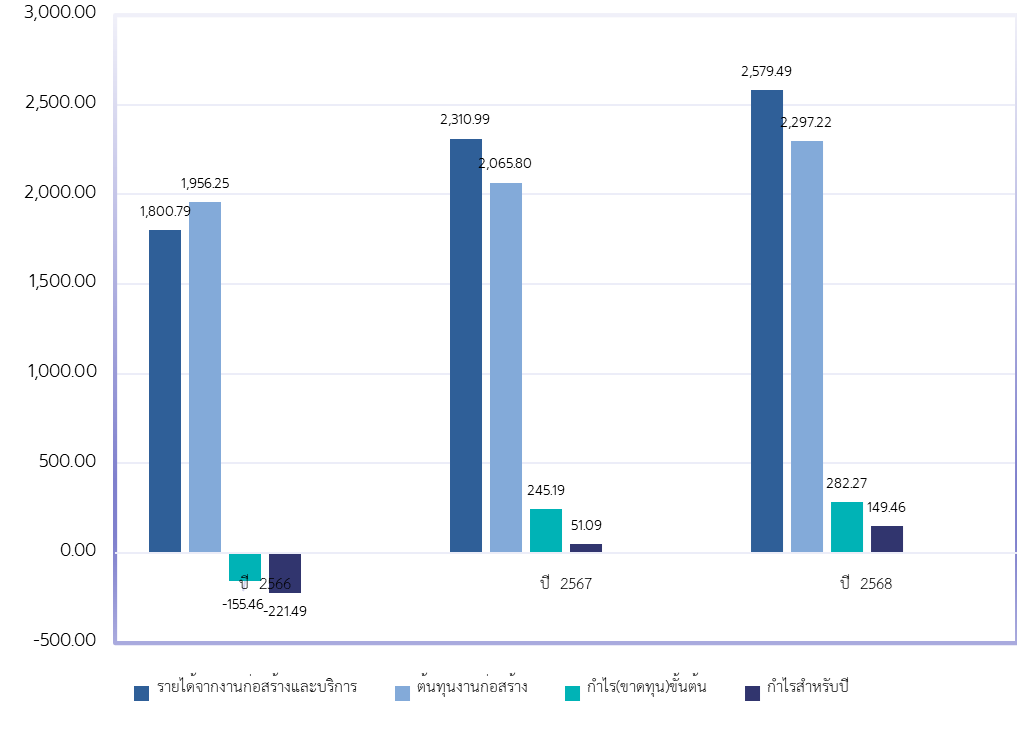
The Group's revenue from construction and services in the year 2023, 2024, and 2025, amounting to Baht 1,800.79 million, Baht 2,310.99 million, and Baht 2,579.49 million, respectively. The details of revenue by recognition method are as follows:
Revenue from construction contracts and services
The Group's revenue from construction and services comprises the agreed contract price plus or minus amounts for changes, additions, or reductions in the scope of work from the original construction contract, which primarily arise from design changes at the construction site as per client requirements. The Group recognizes revenue from services under construction contracts, which are considered performance obligations satisfied over time as construction work progresses. The satisfaction of these performance obligations is measured using the input method, which assesses the progress of construction work based on the ratio of construction costs incurred to date for work completed relative to the total estimated construction costs. In cases where it is highly probable that project costs will exceed the contract revenue, the Group recognizes such estimated losses immediately in the statement of profit or loss. Revenue recognized but not yet due for payment under the contract is presented as unbilled work in progress/contract assets - current, and revenue due for payment under the contract but for which actual construction costs have not yet been incurred is presented as advance construction revenue/contract liabilities - current in the statement of financial position. Furthermore, the Group requires that estimated construction costs be reviewed quarterly to align with actual costs, or whenever any factor significantly impacts the costs of such work.
Summary table of revenue structure by customer type
| Revenue structure | Financial statements showing investments accounted for using the equity method (Audited version) | |||||
| Year 256 6 | Year 256 7 | Year 256 8 | ||||
| Million Baht | Proportion | Million Baht | Proportion | Million Baht | Proportion | |
| Public sector project services | 772.47 | 42.63% | 387.95 | 16.70% | 186.44 | 7.18% |
| Private sector project services | 1,028.32 | 56.75% | 1,923.04 | 82.79% | 2,393.05 | 92.10% |
| Total construction revenue | 1,800.79 | 99.38% | 2,310.99 | 99.49% | 2,579.49 | 99.28% |
| Other income /1 | 11.10 | 0.62% | 11.81 | 0.51% | 18.78 | 0.72% |
| Total revenue |
| 100.00% | 2,322.80 | 100.00% | 2,598.27 | 100.00% |
Source : Information from the company
Note : /1 Other income refers to revenue collected from subcontractors because the subcontractors had insufficient construction labor, so the company provided the labor, and charged expenses to subcontractors, utility income, revenue from the sale of scrap materials
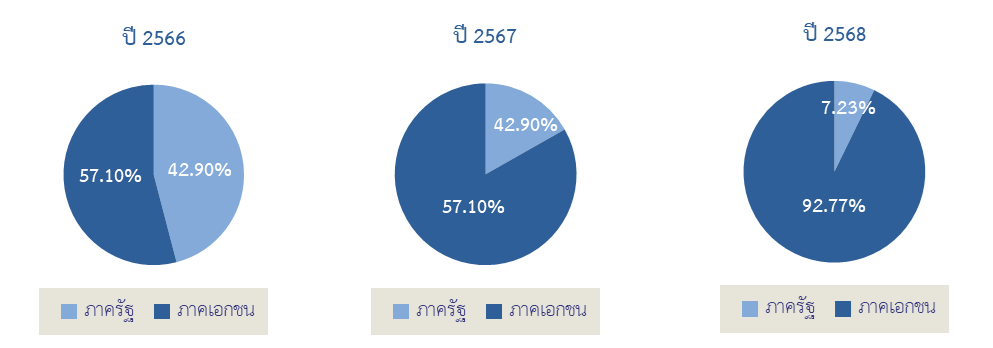
In Year 256 7, the Group's revenue from construction and services amounted to Baht 2,310.99 million, an increase of Baht 510.20 million from 2023, or an increase of 28.33%. This increase in revenue resulted from the company securing 8 additional private sector projects in 2024, with a total project value of Baht 2,871.03 million. Revenue recognized from private sector clients accounted for approximately 83.21% of total construction and services revenue, while revenue from public sector projects accounted for approximately 16.79%.
In 2025, the Group's revenue from construction and services amounted to Baht 2,579.49 million, an increase of Baht 268.50 million from 2024, or an increase of 11.62%. This increase in revenue resulted from the company securing 4 additional private sector projects in 2025, with a total project value of Baht 1,945.27 million. Revenue recognized from private sector clients accounted for approximately 92.77% of total construction and services revenue, while revenue from public sector projects accounted for approximately 7.23%.
Currently, the company continues its strategy of accepting projects by primarily considering risks related to construction site, credibility, and payment capability. Most projects are selected from companies with whom they have previously collaborated, maintaining good relationships and reputation. Competition for projects remains present and has increased over the past year. However, real estate developers with continuous growth plans aim to reduce risks associated with housing delivery to customers, as well as construction issues, and therefore choose to use reliable contractors rather than considering price alone.
Diagram of construction revenue proportion by customer type
Other income
In 2023, 2024, and 2025, the Group had other income of Baht 11.10 million, Baht 11.81 million, and Baht 18.78 million, respectively. This other income comprises labor costs collected from subcontractors due to insufficient construction labor from the subcontractors, for which the company provided the labor and charged the subcontractors, revenue from the sale of scrap materials, utility income, miscellaneous income, and interest income.
Construction costs and gross profit
The Group's main construction and service costs comprise construction materials, subcontractor fees, construction labor and staff expenses, machinery and equipment rental, transportation and relocation costs, spare parts and repair costs for construction machinery and equipment, depreciation, and various overheads. For the accounting periods of 2023, 2024, and 2025, the Group incurred operating costs of Baht 1,956.25 million, Baht 2,065.80 million, and Baht 2,297.22 million, respectively, representing 108.63%, 89.39%, and 89.06% of revenue, respectively. In 2025 and 2024, the Group purchased construction materials from certified suppliers. Green Label 38.04% and 34.64% of the total material purchase amount, representing an increase of 3.40%.
The Group's gross profit for 2023 was Baht (155.46) million, a decrease of Baht 93.70 million from 2022, or a decrease of 151.74%. The gross profit margin for 2023 was (8.63)%, a decrease from the previous year's gross profit margin of (3.73)%. The main reason was the upward adjustment of estimated construction costs for several public sector projects, primarily due to significant increases in construction period extensions, material prices, subcontracting fees, labor costs, and energy costs, which led to a decrease in gross profit from the previous year.
The Group's gross profit for 2024 was Baht 245.19 million, an increase of Baht 400.64 million from 2023, or an increase of 257.72%. The gross profit margin for 2024 was 10.61%, an increase from the previous year's gross profit margin of (8.63)%. This was primarily due to an increase in construction revenue, with revenue recognition and project delivery proceeding as planned, largely from private sector projects that began to recognize more revenue.
The Group's gross profit for 2025 was Baht 282.27 million, an increase of Baht 37.08 million from 2024, or an increase of 15.12%. The gross profit margin for 2025 was 10.94%, an increase from the previous year's gross profit margin of 10.61%. This was primarily due to an increase in construction revenue, with revenue recognition and project delivery proceeding as planned, largely from private sector projects that began to recognize more revenue.
Details of construction costs Year 256 6 - 2025
| Cost of construction and services | Year 256 6 | Year 256 7 | Year 256 8 | ||||||
| Cost value | Percentage of construction cost |
| Cost value | Percentage of construction cost |
| Cost value | Percentage of construction cost |
| |
| Cost of materials and goods | 902.82 | 46.15 | 50.13 | 1,072.36 | 51.91 | 46.40 | 920.36 | 40.06 | 35.68 |
| Subcontractor and labor costs | 772.54 | 39.49 | 42.90 | 873.27 | 42.27 | 37.79 | 1,129.47 | 49.16 | 43.78 |
| Construction costs - excess over construction contract | 57.76 | 2.96 | 3.21 | (101.33) | (4.90) | (4.38) | 0.27 | 0.01 | 0.01 |
| Salaries and employee expenses | 82.26 | 4.20 | 4.57 | 92.61 | 4.48 | 4.00 | 114.75 | 5.00 | 4.45 |
| Electricity, water, telephone, and utilities | 22.59 | 1.15 | 1.25 | 23.60 | 1.14 | 1.02 | 27.50 | 1.20 | 1.07 |
| Travel expenses | 7.16 | 0.37 | 0.40 | 8.15 | 0.39 | 0.35 | 8.67 | 0.38 | 0.34 |
| Depreciation expense | 33.71 | 1.72 | 1.87 | 32.30 | 1.56 | 1.40 | 32.35 | 1.41 | 1.25 |
| Other service costs 1 | 77.41 | 3.96 | 4.30 | 64.84 | 3.13 | 2.81 | 63.85 | 2.78 | 2.48 |
| Total | 1,956.25 | 100.00 | 108.63 | 2,065.80 | 100.00 | 89.39 | 2,297.22 | 100.00 | 89.06 |
Note: /1 Other service costs include miscellaneous expenses, consumable materials, transportation costs, fees, and repair costs, etc.
Selling and administrative expenses
In 2025, the company's selling and administrative expenses amounted to Baht 98.31 million, an increase of Baht 16.70 million from the same period in 2024, or an increase of 20.47%. In 2024, the administrative expense ratio was 3.51% of total revenue, and in 2025, it was 3.78% of total revenue. The main reason for this increase was the recognition of a provision for non-current contract assets totaling Baht 12.01 million.
Financial costs
The Group incurred financial costs for the accounting periods of 2023, 2024, and 2025 totaling Baht 7.40 million, Baht 11.26 million, and Baht 10.23 million, respectively, or 0.41%, 0.49%, and 0.40% of revenue from construction and services in each year. All financial expenses are interest expenses arising from the use of credit facilities from financial institutions, primarily commercial credit lines such as interest on promissory notes (PN), overdraft interest, hire-purchase creditor interest, and interest from long-term loans from financial institutions.
Net profit
In 2025, the company's net profit was Baht 149.46 million, an increase of Baht 98.36 million from the same period in 2024, or an increase of 192.52%. This increase was primarily due to the company's ability to recognize revenue from construction and deliver private sector projects according to plan.
Liquidity & Capital Adequacy
Cash Flow | Year 2023 Jan - Dec | Year 2024 Jan - Dec | Year 2025 Jan - Dec |
| million Baht | million Baht | million Baht | |
| Net cash provided by (used in) operating activities | (133.74) | As of December 31, 2023, 2024, and 2025, the Group had advances received from construction contracts totaling Baht 317.43 million, Baht 207.93 million, and Baht 231.42 million, respectively, representing 20.17 percent, 13.07 percent, and 15.53 percent of total liabilities and shareholders' equity, respectively. These contract liabilities - current will be deducted from the value recognized by the Group as revenue based on the percentage of work completed in the subsequent period for those projects. | 451.13 |
| Net cash provided by (used in) investing activities | 8.12 | (4.06) | (60.13) |
| Net cash provided by (used in) financing activities | 99.05 | (201.51) | (149.33) |
| Net increase (decrease) in cash and cash equivalents | (26.57) | (61.56) | 241.68 |
Cash flow from operating activities
The Group had net cash provided by (used in) operating activities of (Baht 133.74) million, Baht 144.01 million, and Baht 451.13 million in 2023, 2024, and 2025, respectively.
For the year 2025, the Group had net cash provided by (used in) operating activities of Baht 451.13 million, an increase of Baht 307.12 million from 2024. The main reason for this increase was the Group's receipt of payments for construction work.
Cash flow from investing activities
The Group had net cash provided by (used in) investing activities of Baht 8.12 million, (Baht 4.06) million, and (Baht 60.13) million in 2023, 2024, and 2025, respectively. The Group's main investment items included the purchase of fixed assets totaling Baht 62.50 million in 2025 to replace old, deteriorated assets and to enhance efficiency and reduce long-term construction costs.
Cash flow from financing activities
The Group had net cash provided by (used in) financing activities in 202 6, 2024, and 2025, totaling Baht 99.05 million, (Baht 201.51) million, and (Baht 149.33) million, respectively.
For the year 2023, the Group had net cash provided by (used in) financing activities of Baht 99.05 million. The majority of the cash provided by (used in) financing activities in that year resulted from net cash provided by (used in) short-term loans from financial institutions totaling 1 38.29 million Baht
For the year 2024, the Group had net cash provided by (used in) financing activities of (Baht 201.51) million, which resulted from net cash provided by (used in) the repayment of short-term loans from financial institutions totaling Baht 162.32 million.
For the year 2025, the Group had net cash provided by (used in) financing activities of (Baht 149.33) million, which resulted from net cash provided by (used in) the repayment of short-term loans from financial institutions totaling Baht 106.93 million.
Liabilities
As of December 31, 2023, 2024, and 2025, the Group had total liabilities of Baht 1,276.44 million, Baht 1,242.16 million, and Baht 991.94 million, respectively, representing 81.09 percent, 78.08 percent, and 66.57 percent of total liabilities and shareholders' equity, respectively. Significant changes in liabilities are as follows:
Short-term loans from financial institutions
As of December 31, 2023, 2024, and 2025, the Group had short-term loans from financial institutions totaling Baht 320.02 million, Baht 157.70 million, and Baht 50.77 million, respectively. The decrease in short-term loans from financial institutions was due to the Group's repayment of these loans to banks and a reduction in the use of promissory note credit facilities ( PN) and avalized bills
Trade and other current payables
The Group's trade and other current payables consist of trade payables for materials, subcontractors, retention payables, and advances received from construction contracts, among others. As of As of December 31, 2023, 2024, and 2025, the Group had trade and other payables totaling Baht 381.83 million, Baht 649.93 million, and Baht 537.01 million, respectively, representing 24.26 percent, 40.85 percent, and 36.04 percent of total liabilities and shareholders' equity, respectively.
As of As of December 31, 2024, trade and other current payables increased by Baht 268.10 million, or 170.22 percent, compared to December 31, 2023. The aforementioned liabilities represent normal trade payables or accrued expenses of the Group that are not yet due, and their amount increased in line with the increasing number and cumulative value of the Group's construction projects.
As of December 31, 2025, trade and other current payables decreased by Baht 112.92 million, or 17.37 percent, compared to December 31, 2024. The aforementioned liabilities represent normal payments to creditors or accrued expenses of the Group.
Contract liabilities - current
Contract liabilities - current, or advances received from construction contracts, represent the value of construction work that the Group has collected from customers according to the contract, which is greater than the value recognized by the Group as revenue based on the percentage of work completed. As of
As of December 31, 2024, advances received from construction contracts decreased by Baht 109.50 million, or 34.50 percent, compared to advances received from construction contracts as of December 31, 2023. This was primarily due to intense market competition in securing projects, which impacted the negotiation of advance payments from clients. In 2024, the Group secured 8 additional private sector projects, but the proportion of advance payments received from clients decreased compared to the previous year. It also resulted from the refund of advance payments to a government agency client due to the cancellation of a construction contract, amounting to Baht 53.12 million.
As of December 31, 2025, advances received from construction contracts increased by Baht 23.49 million, or 11.30 percent, compared to advances received from construction contracts as of December 31, 2024. This was primarily due to the Group signing several project contracts during 2025, leading to the gradual collection of advance payments from customers for construction work. As work began to be progressively delivered, the difference between the value of construction work collected by the Group from customers according to the contract and the value recognized by the Group as revenue based on the percentage of work completed increased.
Liabilities under finance leases
The Group's liabilities under finance leases represent finance lease agreements between the Group and leasing companies for the lease-purchase of machinery and vehicles used in business operations. Typically, lease-purchase agreements have an average term of approximately 5 years. As of December 31, 2023, 2024, and 2025, the Group had liabilities under finance leases totaling Baht 28.80 million, Baht 15.30 million, and Baht 8.30 million, respectively, representing 1.83 percent, 0.96 percent, and 0.56 percent of total liabilities and shareholders' equity, respectively.
Table of Liabilities under Finance Leases
| Liabilities under finance leases | Dec 31, 2023 | Dec 31, 2024 | Dec 31, 2025 | |||
| million Baht | Percentage | million Baht | Percentage | million Baht | Percentage | |
| Finance lease liabilities | ||||||
| 16.55 | 57.47 | 14.19 | 92.76 | 4.69 | 56.48 |
| 12.25 | 42.53 | 1.11 | 7.24 | 3.61 | 43.52 |
| Total liabilities under finance leases | 28.80 | 100.00 | 15.30 | 100.00 | 8.30 | 100.00 |
Long-term loans
Long-term loans represent borrowings from financial institutions primarily used for the Group's construction activities. As of December 31, 2023, 2024, and 2025, the Group had long-term loans from financial institutions totaling Baht 56.65 million, Baht 136.50 million, and Baht 110.05 million, respectively, representing 3.60 percent, 8.58 percent, and 7.39 percent of total liabilities and shareholders' equity.
Table of Loans from Financial Institutions
| Loans from financial institutions | Dec 31, 2023 | Dec 31, 2024 | Dec 31, 2025 | |||
| million Baht | Percentage | million Baht | Percentage | million Baht | Percentage | |
| Loans from financial institutions | ||||||
| 19.08 | 33.68 | 43.57 | 31.92 | 36.41 | 33.08 |
| 37.57 | 66.32 | 92.93 | 68.08 | 73.64 | 66.92 |
| Total loans from financial institutions | 56.65 | 100.00 | 136.50 | 100.00 | 110.05 | 100.00 |
Non-current provisions for employee benefits
Non-current provisions for employee benefits represent the Group's obligation to pay compensation to employees upon their departure, calculated based on actuarial principles. As of December 31, 2023, 2024, and 2025, the Group had employee benefit obligations of Baht 5.65 million, Baht 7.20 million, and Baht 9.87 million, respectively, representing 0.36 percent, 0.45 percent, and 0.66 percent of total liabilities and shareholders' equity, respectively.
As of December 31, 2024, employee benefit obligations increased by Baht 1.55 million, or 27.44 percent, compared to December 31, 2023.
As of December 31, 2025, employee benefit obligations increased by Baht 2.67 million, or 37.12 percent, compared to December 31, 2024.
Other non-current provisions
Long-term provisions/other non-current provisions represent estimated costs that may arise during the warranty period for work. As of December 31, 2023, 2024, and 2025, the Group had long-term provisions totaling Baht 38.82 million, Baht 41.68 million, and Baht 44.52 million, respectively, representing 2.47 percent, 2.62 percent, and 2.99 percent of total liabilities and shareholders' equity, respectively.
As of December 31, 2024, long-term provisions/other non-current provisions increased by Baht 2.86 million, or 7.36 percent, compared to December 31, 2023. This was a result of the warranty period for the Group's projects.
As of December 31, 2025, long-term provisions/other non-current provisions increased by Baht 2.84 million, or 6.81 percent, compared to December 31, 2024. This was a result of the warranty period for the Group's projects.
Shareholders' equity
The Group's shareholders' equity as of December 31, 2024, amounted to Baht 348.67 million, an increase compared to shareholders' equity of Baht 297.57 million as of December 31, 2023. This increase was due to the Group's operating profit.
The Group's shareholders' equity as of December 31, 2025, amounted to Baht 498.12 million, an increase compared to shareholders' equity of Baht 149.46 million as of December 31, 2024. This increase was due to the Group's operating profit.
Asset Management Capability
Assets
As of December 31, 2023, 2024, and 2025, the Group had total assets of Baht 1,574.02 million, Baht 1,590.83 million, and Baht 1,490.07 million, respectively. The significant asset items affecting the change in total assets are as follows:
Cash and cash equivalents
Cash and cash equivalents consist of cash on hand and bank deposits. As of December 31, 2023, 2024, and 2025, the Group had cash and cash equivalents totaling Baht 104.28 million, Baht 42.72 million, and Baht 284.40 million, respectively. The amount in 2025 increased compared to 2024 due to the Group receiving more debt payments from debtors.
Trade and other current receivables
The company's trade and other current receivables consist of receivables from construction contracts, advances for goods, advances for subcontracting, unexpired input tax, prepaid insurance, post-dated cheques, etc. As of December 31, 2023, 2024, and 2025, the Group had trade and other receivables totaling Baht 241.74 million, Baht 484.09 million, and Baht 324.25 million, respectively. The Group's net trade receivables as of December 31, 2023, 2024, and 2025 amounted to Baht 148.92 million, Baht 411.77 million, and Baht 280.44 million, respectively, representing 9.46%, 25.88%, and 18.82% of total assets, respectively. The Group recognizes trade receivables based on invoices issued to customers for completed work stages after delivery. Generally, the Group's policy is to grant credit terms of 30–60 days to customers.
As of December 31, 2024, net trade receivables increased by Baht 262.85 million or 176.50% from December 31, 2023. The Group's outstanding receivables at the end of 2024 primarily relate to ongoing projects for private sector clients.
As of December 31, 2025, net trade receivables decreased by Baht 131.32 million or 31.89% from December 31, 2024. The Group's outstanding receivables at the end of 2025 primarily relate to ongoing projects for private sector clients.
As of December 31, 2023, 2024, and 2025, the company had outstanding receivables categorized by aging as follows:
Trade receivables | Dec 31, 2023 | Dec 31, 2024 | Dec 31, 2025 |
Not yet due | 125.64 | 345.73 | 207.88 |
| |||
Less than 3 months | 23.28 | 57.12 | 72.56 |
| - | 9.28 | - |
More than 6 – 12 months | - | - | - |
Total trade receivables | 148.92 | 411.77 | 280.44 |
Other receivables | 92.82 | 72.32 | 43.80 |
Total trade and other receivables | 241.74 | 484.09 | 324.24 |
Assets arising from contracts - current
As of December 31, 2023, 2024, and 2025, the Group had value of current contract assets totaling Baht 343.26 million, Baht 208.38 million, and Baht 49.46 million, respectively. As of December 31, 2025, the value decreased by Baht 158.92 million from December 31, 2024, primarily due to government projects. The value of current contract assets is presented at the net expected recoverable amount using the percentage-of-completion method, calculated based on the ratio of costs incurred for services rendered to the total estimated costs for providing construction services. The Group has not yet issued invoices for collection as the payment due date specified in the project contracts has not yet arrived.
Inventories
Inventories consist of unused construction materials that the Group has ordered according to the planned schedule and stored at project sites for readiness of use. As of December 31, 2023, 2024, and 2025, the Group had construction materials inventories totaling Baht 51.81 million, Baht 27.77 million, and Baht 29.18 million, respectively. These primarily include ready-mix concrete, paint, deformed bars, rebar, and equipment awaiting installation for projects, and considering the trend of increasing material prices.
Assets arising from contracts - non-current
Assets arising from contracts - non-current. As of December 31, 2023, 2024, and 2025, the Group had assets arising from contracts - non-current totaling Baht 222.92 million, Baht 247.29 million, and Baht 256.64 million, respectively, representing 14.16%, 15.54%, and 17.22% of total assets, respectively.
Pledged bank deposits
Pledged bank deposits/other non-current financial assets/other non-current financial assets refer to fixed deposit accounts held with financial institutions, which the Group uses as collateral for credit lines to issue letters of guarantee. As of December 31, 2023, 2024, and 2025, the Group had pledged bank deposits totaling Baht 35.88 million, Baht 27.87 million, and Baht 26.64 million, respectively, representing 2.28%, 1.75%, and 1.79% of total assets, respectively. The increase/decrease in such deposits is consistent with the acceptance of new construction projects in 2024 and 2025.
Land, buildings, and equipment
As of December 31, 2023, 2024, and 2025, the Group had land, buildings, and equipment totaling Baht 364.37 million, Baht 345.55 million, and Baht 401.85 million, respectively. In 2025, the Group purchased fixed assets amounting to Baht 62.50 million to enhance efficiency and reduce long-term costs.
Right-of-use assets
In 2025, the Group recognized right-of-use assets at the lease commencement date. Right-of-use assets are measured at cost less accumulated depreciation, accumulated impairment losses, and adjusted for the remeasurement of lease liabilities. The cost of right-of-use assets comprises the amount of the lease liability measured at initial recognition, initial direct costs incurred, and lease payments made at or before the lease commencement date. effective on or before the commencement date of the lease and reduced by lease incentives received. The Group adopted this financial reporting standard, recognizing the cumulative effect of the initial application of this financial reporting standard.
As of December 31, 2023, 2024, and 2025, the Group's right-of-use assets amounted to Baht 54.54 million, Baht 47.12 million, and Baht 15.85 million, respectively, representing 3.46%, 2.96%, and 1.06% of total assets. In 2025, right-of-use assets decreased by Baht 31.26 million or 66.36% compared to 2024.
Intangible assets
The Group's intangible assets primarily consist of computer software licenses. The net value as of December 31, 2023, 2024, and 2025 amounted to Baht 1.03 million, Baht 0.56 million, and Baht 1.17 million, respectively, representing 0.07%, 0.04%, and 0.08% of total assets, respectively. The main intangible assets of The Group's intangible assets include computer software licenses for Enterprise Resource Planning (ERP) systems, which the Group uses for management. In 2025, the Group's cost of computer software licenses increased from 2024, resulting in an increase in intangible assets in 2025 by Baht 0.61 million or 109.59%. This increase is primarily due to the amortization of assets over their useful lives from the Group's normal operations.
Deferred income tax assets
Deferred income tax assets arise from deductible temporary differences, including unused tax losses, for which the Group expects to have sufficient future taxable profits to utilize these deductible temporary differences and unused tax losses. As of December 31, 2023, 2024, and 2025, the Group had deferred income tax assets totaling Baht 63.85 million, Baht 36.80 million, and Baht 30.96 million, respectively, representing 4.06%, 2.31%, and 2.08% of total assets, respectively. The Group's deferred income tax assets primarily comprise temporary differences from expected credit losses, long-term provisions, provisions for construction losses, non-current provisions for employee benefits, etc.
Other non-current assets
Other non-current assets of the Group consist of Retention receivables from construction contracts Primarily, corporate income tax withheld at source, performance bonds for supervision, deposits, and utility guarantees. As of December 31, 2023, 2024, and 2025, the Group had other non-current assets totaling Baht 90.33 million, Baht 122.69 million, and Baht 69.67 million, respectively, representing 5.74%, 7.71%, and 4.68% of total assets, respectively.
Debt Obligations & Off-Balance-Sheet Management
The Group has disclosed its commitments in Note 29 to the financial statements.
Debt Securities with Financial Ratio Requirements
Debt Securities with Financial Ratio Requirements Issued?
No
Factors That May Affect Financial Condition
Factors or Incidents That May Materially Affect Financial Condition
In 202 8. The company has sales awaiting recognition and delivery totaling 9 projects, with a total project value of approximately 4,321.77 million Baht. The remaining work value at year-end is 2,037.82 million Baht. During 2024, the company continued to receive trust from clients who awarded it continuous work. This is due to the quality of the company's construction operations, adherence to planned schedules, maintenance of quality work standards, compliance with contractual terms, development of personnel and construction technology, and continuous adherence to business ethics. As a result, in 2025, the company commenced construction on 3 new condominium projects and 1 hotel construction project, with a total construction value of 1,945.27 million Baht, which helps the group of companies generate continuous revenue, including:
Project The Title Heritage Bangtao (Condominium) Contract value 364.49 million Baht
Project The Title Artrio Bang-Tao (Condominium) Contract value 688.10 million Baht
Project Atmind Central Pattaya Hotel (Hotel) Contract value 448.76 million Baht
Project Atmoz De Sol Thipphawan Station (Condominium) Contract value 443.92 million Baht
Positive Factors ( Opportunities & Strengths)
Strong Backlog — Stable Revenue achieved record-high revenue for the consecutive year. 2, at 2,579 million Baht, a growth of 12%, and a net profit of 149 million Baht, an increase of 193% compared to the previous year. The company has also secured several new construction projects, leading to a continuous surge in its backlog.
Growth Target for 2026 For the operational direction in 2026, the company has set a growth target of 10% and is proceeding with its business expansion plan into new potential markets.
Customer Base Diversification — Reducing Real Estate Risks The company aims to diversify its risks into new markets, particularly government infrastructure projects, and expand into the factory and hospital client segments to reduce reliance on real estate clients.
New Business Expansion — Hotels & Construction Materials The company is aggressively entering the hotel market with investments. 10 million Baht to establish "Studio Metal" to penetrate the construction and decoration materials business, reflecting a diversification of revenue streams.
Cost Control Capability The outstanding performance reflects the potential in project management, efficient cost control, and the ability to maintain profit margins amidst intense competition.
Risk Factors ( Risks & Challenges)
Real Estate Market Volatility The company's core business remains tied to the real estate market, including condominiums and office buildings. The company provides construction contracting services for buildings and structures to both public and private sectors, such as low-rise and high-rise condominiums, hospitals, and office buildings. If the real estate market slows down, it will directly impact the acquisition of new projects.
High Industry Competition The company's success stems from consistently retaining its existing customer base while continuously expanding to new clients. This indicates a highly competitive market, and retaining existing customers is a crucial factor for revenue sustainability.
Construction Material and Labor Costs In the current competitive business environment, the most critical factor for clients is construction costs. Fluctuations in material prices and labor wages directly impact project profit margins, especially for fixed-price contracts.
Project Delivery Risk The decline in net profit and net profit margin in some years is primarily due to delayed work area handover, which is a significant operational risk for the contracting business.
Risks from Government Policies and Budget The company prioritizes preparing measures to prevent and manage various risks, both short-term and long-term, to maintain business continuity, especially regarding reliance on government projects which depend on annual budget allocations.
The company will focus on strengthening its core business in constructing high-value and complex buildings such as hotels, hospitals, and high-end condominiums. High-end, which aligns with the company's expertise and shows growth potential from the recovery of the tourism sector and the development of mixed-use projects. Furthermore, the company can extend into Wellness Real Estate projects such as Wellness Hotels, Healthcare Facilities, and Wellness Communities, which are new trends in the real estate market emphasizing health and quality of life. These projects remain within the high-value building segment where the company already has experience. Therefore, the company will closely monitor the quality of business opportunities and the value of its backlog, focusing on the work selection process, customer quality assessment, payment terms, delivery team readiness, and appropriate profit margins, to ensure that revenue growth is of high quality and does not accumulate future risks.