

Risk Management · 2025
In this section3 topics
Risk Management Policy & Plan
Policy & Plan Description
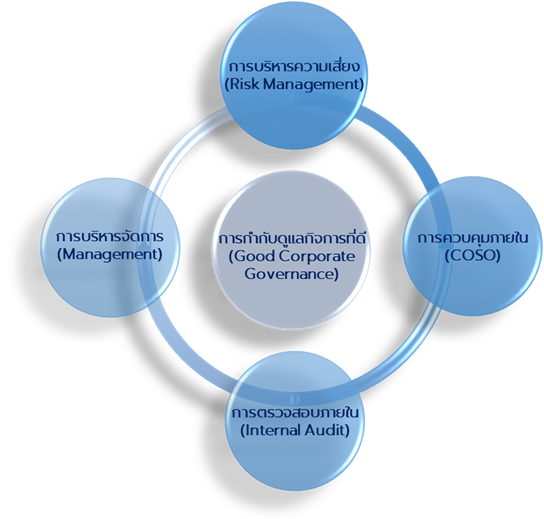
The company has risk management guidelines in accordance with international standards ( COSO Enterprise Risk Management Framework : COSO ERM Framework), which the company recognizes and appreciates the importance of good corporate governance to drive stable organizational growth and business expansion, maintain a strong financial position, and generate appropriate returns for shareholders, as well as operate according to the principles of Good Corporate Governance, with internal quality control systems and performance evaluation systems. Therefore, the Board of Directors deems it appropriate to implement risk management to ensure good corporate governance and enhance confidence among shareholders and stakeholders. To ensure that the overall organizational risk is at an acceptable level, the following risk management policy is established:
-
Stipulate that risk management is the responsibility of employees at all levels and in all departments.
who must be aware of the risks involved in their departmental and organizational operations, with an emphasis on managing various aspects of risk to ensure that risks are at an adequate and appropriate level. -
An enterprise risk management process is in place, adhering to international standards, to ensure efficient risk management, foster development, and align operations across the organization. This includes focusing on achieving defined objectives, goals, vision, mission, and strategies to create operational excellence and build confidence among stakeholders.
-
Guidelines are established for managing operational risks of the company to avoid potential damage or losses, including regular monitoring and evaluation.
-
Develop the use of information technology systems as a communication channel in the company's risk management process, enabling personnel at all levels to access information comprehensively, and efficiently manage the risk management reporting system for the organization's Risk Management Committee.
Risks to the Company's Business Operations
Introduction
The assessment of key risks in the company's business operations (Key Risk) involves analysis of both internal and external factors, as well as future trends that may impact the organization's short-term, medium-term, and long-term objectives. The occurrence of such risks is monitored and observed, and risk management plans are developed to address these issues and mitigate their impact on operational goals in 2024. The company has assessed significant risks in alignment with its corporate business plan and sustainable business development, encompassing environmental, social, and governance dimensions, as follows:
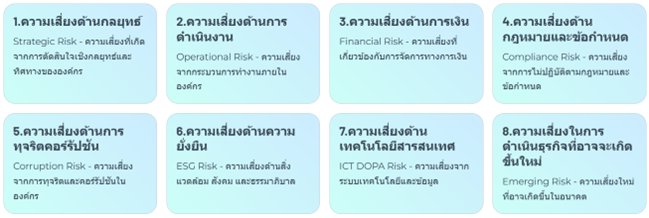
Risk Register
| Risk Name | Risk Characteristics | Consequences | Management Measures | Related Risk Factors | ||||||||||||||||||||||||||||||||||||
|---|---|---|---|---|---|---|---|---|---|---|---|---|---|---|---|---|---|---|---|---|---|---|---|---|---|---|---|---|---|---|---|---|---|---|---|---|---|---|---|---|
| Strategic Aspect | Risks (S01) : Retaining existing customers Customer demands for product quality and timely delivery, along with expectations for increased use of environmentally friendly materials, may impact the retention of existing customers. Therefore, the company has measures in place to use environmentally friendly products, with a target for 2025. Procurement is conducted with Green Label certified suppliers, with the value of environmentally friendly procurement in 2025. Amounting to 577 million Baht Representing 32 percent % which increased from the previous year. to 12% The procured materials are divided into office supplies, including environmentally friendly paper, and construction materials such as concrete, steel, lightweight bricks, tile adhesive-grout, building paint, electrical transformers, sanitary ware, precast walls, tiles, and others, with specified supplier qualifications for providing environmentally friendly materials. which is at a risk level that the company can still manage.
Opportunities (S02) : Target new potential customer groups. The company aims to accommodate more potential new customer groups. Maximizing cost and project management efficiency, and focusing on high-potential niche markets with fewer competitors, will be key to driving exponential profit growth.
Opportunities (S03) : Increase the proportion of projects undertaken in economically potential areas where the company has a competitive advantage. The company aims to increase the proportion of projects undertaken in economic areas and must build confidence and trust among customers in these economic areas, demonstrating the company's potential and creating a positive image.
Risks (S04) : Reduce carbon emissions and promote a circular economy. The organization has a strong internal management system, aligned with external drivers, and strictly adheres to good governance principles. Balancing economic returns with social and environmental responsibility will be key to creating true long-term value.
Risks (S05) : Promote the safety and quality of life of workers. The organization has a strong internal management system, aligned with external drivers, and strictly adheres to good governance principles. Balancing economic returns with social and environmental responsibility will be key to creating true long-term value.
Opportunities (S06) : Create a transparent management system. The organization has a strong internal management system, aligned with external drivers, and strictly adheres to good governance principles. Balancing economic returns with social and environmental responsibility will be key to creating true long-term value.
Opportunities (S07) : Establish a working group to study the implementation of AI technology within the organization. The company can invest in new technologies such as BIM, IoT, or AI, while promoting learning, change, and innovation among personnel to develop technological skills or be open to learning new things that will help effectively implement technology, and promoting smart construction.
| Risk (S01): Retaining existing customer base
Risk (S02): Penetrate new potential customer segments
Opportunity (S03): Increase the proportion of projects undertaken in economically potential areas where the company has a competitive advantage Opportunity Details
Risk Details
Risk (S04): Reduce carbon emissions and promote circular economy
Opportunity (S05): Promote worker safety and quality of life
Opportunity (S06): Establish a transparent management system
Opportunity (S07): Establish a working group to study the application of AI technology in the organization Opportunity Details
Risk Details
| Risk (S01): Retaining existing customer base.
Risk (S02): Target new potential customer groups.
Opportunity (S03): Increase the proportion of projects undertaken in economically potential areas where the company has a competitive advantage. Opportunity details.
Risk details.
Risk (S04): Reduce carbon emissions and promote a circular economy.
Opportunity (S05): Promote worker safety and quality of life.
Opportunity (S06): Establish a transparent management system.
Opportunity (S07): Form a working group to study the implementation of AI technology within the organization. Opportunity details.
Risk details.
| 729 · Description: Behavior or needs of customers / consumers · Info category: STRATEGIC_RISK · 734 · Description: Reliance on large customers or few customers · Info category: STRATEGIC_RISK · 1714 · Description: Competition risk · Info category: STRATEGIC_RISK · 749 · Description: Safety, occupational health, and working environment · Info category: OPERATIONAL_RISK · 1719 · Description: Climate change and disasters · Info category: STRATEGIC_RISK | ||||||||||||||||||||||||||||||||||||
| Operational Risk | Risk (O01) : Risk of penalties. Delayed project delivery, influenced by various factors such as contract terms, unclear specifications, labor shortages, delayed material approvals, and insufficient reserve funds, poses a risk of future penalties.
Risk (O02) : Performance according to the defined work plan. Delayed project delivery, influenced by various factors such as contract terms, unclear specifications, labor shortages, delayed material approvals, and insufficient reserve funds, poses a risk of future penalties.
Risk (O03) : Labor shortage. The company undertakes projects in the Bangkok metropolitan area, as well as strategic areas (EEC / SEC), where labor is essential for timely completion and delivery according to contract schedules. Additionally, conflicts between Thailand and Cambodia directly impact the labor force in project management.
Risk (O04) : Accidents in the construction area. Negligence regarding workplace safety, affecting both individuals and company assets, poses a risk that could impact operations and surrounding areas.
Opportunity (O05) : Management of essential resources to be appropriate, sufficient, and maximally efficient. The company prioritizes Zero Waste or Circular Economy by reusing or transforming residual resources to create value. Furthermore, the company has standards and procedures for procurement, utilization, and approval of resources, which contributes to cost control and waste reduction. The use of the Mango system, an effective project management system, also enables more accurate tracking, monitoring, and allocation of resources.
Risk (O06) : The working environment is exposed to floods. The company prioritizes safety in construction project management, including potential occurrences from natural disasters such as fires, storms, floods, and earthquakes. These are external factors that are difficult to control, but preparedness and response to these emergencies can be implemented to ensure business operations achieve the goals agreed upon with clients and partners.
Risk (O07) : The working environment is exposed to increasingly hot weather. The company prioritizes safety in construction project management, including potential occurrences from natural disasters such as fires, storms, floods, and earthquakes. These are external factors that are difficult to control, but preparedness and response to these emergencies can be implemented to ensure business operations achieve the goals agreed upon with clients and partners.
| Risk (O01) : Risk of being fined
Risk (O02) : Operations according to the defined plan
Risk (O03) : Labor shortage
Risk (O04) : Accidents in the construction area
Opportunity (O05) : Management of essential resources to be appropriate, sufficient, and maximally efficient
Risk (O06) : Working environment facing floods
Risk (O07) : Working environment facing rising hot temperatures
| Risk (O01). : Risk of being fined.
Risk (O02). : Performing work according to the defined plan.
Risk (O03). : Labor shortage.
Risk (O04). : Accidents in construction areas.
Opportunity (O05). : Management of essential resources to be adequate, appropriate, and maximally efficient.
Risk (O06). : Working environment facing floods.
Risk (O07). : Working environment facing increasingly hot weather.
| 739 · Description: Shortage or reliance on skilled workers · Info category: OPERATIONAL_RISK · 742 · Description: Human error in business operations · Info category: OPERATIONAL_RISK · 744 · Description: Information security and cyber-attack · Info category: OPERATIONAL_RISK · 745 · Description: Loss or damage from non-compliance of partners or counterparties · Info category: OPERATIONAL_RISK · 749 · Description: Safety, occupational health, and working environment · Info category: OPERATIONAL_RISK · 750 · Description: Climate change and disasters · Info category: OPERATIONAL_RISK · 751 · Description: Impact on the environment · Info category: OPERATIONAL_RISK | ||||||||||||||||||||||||||||||||||||
| Financial Risk | Risk (F01) : Lack of internal working capital The construction contracting business requires sufficient working capital for expanding project acquisition, as it is necessary to reserve funds for bidding, performance guarantees, and construction operations. If financial liquidity management is inadequate, the company may not be able to undertake new construction projects or may not be able to complete various construction projects as stipulated in the contract. However, the company is aware of this risk and has therefore established measures and policies to mitigate it by securing funding from various sources to maintain emergency reserves in line with management and company expansion. This includes managing appropriate short-term and long-term funding sources to ensure sufficient liquidity for business operations. The company reviews and monitors project expenditure plans, as well as controls inventory procurement to an appropriate and efficient level, and maintains sufficient cash and cash equivalents for the company's operations to reduce the impact of cash flow fluctuations.
| Risk Aspect (F01): Insufficient internal working capital
| Risk (F01): Lack of working capital within the company
| 1724 · Description: Liquidity risk · Info category: FINANCIAL_RISK | ||||||||||||||||||||||||||||||||||||
| Legal and Corporate Requirements Risk | Risk Aspect (C01) : Risk of lawsuits (complaints from communities surrounding the project) As the construction contracting business operates under various laws, regulations, and oversight, including acts and royal decrees, it may face risks related to safety or environmental impact. Such unforeseen events could lead to complaints/lawsuits from surrounding communities, various sectors, and/or opposition that prevents construction from proceeding as per the contract.
| Risk (C01): Risk of lawsuits (complaints from communities around the project)
| Risk Aspect (C01): Litigation risk (Complaints from communities around the project).
| 1723 · Description: Legal risk · Info category: COMPLIANCE_RISK | ||||||||||||||||||||||||||||||||||||
| Corruption | Risks (CR01) : Risks related to policy formulation and anomaly reporting procedures. The company anticipates risks that may arise from employees' improper gain, such as giving or receiving bribes, which may include money, goods, financial assistance, or other expenses. This could impact the company's image and reputation, financial damage, and trust from customers, partners, and society. Therefore, the company has implemented measures to establish a clear and strict anti-corruption policy and communicates this corruption policy to personnel. It also provides channels for complaints/whistleblowing and enhances anti-corruption prevention measures. Audits are conducted, and internal control systems are strengthened to prevent potential risks.
| Risk Aspect (CR01): Risk related to policy formulation and abnormal reporting procedures
| Risk Aspect (CR01): Risks related to policy formulation and procedures for reporting irregularities.
| 754 · Description: Corruption · Info category: OPERATIONAL_RISK | ||||||||||||||||||||||||||||||||||||
| Sustainability | Risk Aspect: Sustainable Risk Management The construction contracting business requires water in several stages, such as concrete mixing, cement curing, cleaning, and spraying construction areas to reduce dust. High water consumption may lead to water scarcity issues in nearby areas. Furthermore, the construction contracting business also requires electricity for operating heavy machinery, power tools, and lighting systems in construction areas. Electricity consumption impacts cost control in business operations. Additionally, there is a focus on employee welfare, equality, and diversity within the organization, which helps foster motivation and engagement, factors contributing to social sustainability, and also promotes transparency.
| Risk aspect : Sustainable risk management ESG01 : High water consumption in construction
ESG02 : High electricity consumption in construction work
ESG03 : Neighboring communities reporting nuisances
ESG04 : Social
| Risk Aspect: Sustainable Risk Management ESG01 : High water consumption in construction
ESG02: High electricity consumption in construction work
ESG03: Neighboring communities report nuisances
ESG04: Social
| 1717 · Description: ESG risk · Info category: STRATEGIC_RISK | ||||||||||||||||||||||||||||||||||||
| Information Technology Risk | Risks arising from errors or vulnerabilities of threats affecting devices may stem from device malfunctions, improper device installation in unsuitable locations, exposure to various threats, such as computer viruses, among others. | ICT01 : Cyber Security Risk | ICT01 : CYBER Security Risks
| 732 · Description: Changes in technologies · Info category: STRATEGIC_RISK · 744 · Description: Information security and cyber-attack · Info category: OPERATIONAL_RISK | ||||||||||||||||||||||||||||||||||||
| The company's current and emerging business operational risks. | Risk Issues. : Emerging operational risks in the future. The slowdown in investment by construction business clients directly impacts the organizational context of construction contractors, leading to various internal management risks and challenges, such as financial and liquidity risks. , Resource management, Competitiveness and operational capabilities. Investment expansion by establishing Studio Metal Solution Co., Ltd. to engage in the business of distributing and marketing construction materials, decorative materials, and architectural metalwork, as well as providing design services, product development, project management, and digital marketing.
Assessment of significant risky events during Q1-2026, which the risk committee will re-evaluate in detail.
| Opportunity details E01 : Delay in customer investment E02 : Economic aspects Risk details E03 : The company possesses strengths in premium market positioning, support from the parent company, and growth in the luxury design market. E04 : War or geopolitical conflict
| Opportunity Details. E01 : Customer investment slowdown.
E02 : Economic Aspect
Risk Details. E03 : The company's strengths include its premium market positioning, support from the parent company, and the growth of the luxury design market.
E04 : War conditions or geopolitical conflicts.
| 1715 · Description: Economic risk · Info category: STRATEGIC_RISK |
Risks to Securities Holders' Investment
Risk Register
| Risk Name | Risk Characteristics | Consequences | Management Measures | Related Risk Factors |
|---|---|---|---|---|
| Risk from a major shareholder holding more than 25 percent | Risk from the company having a major shareholder holding more than 25% | Risk from the company having a major shareholder holding more than 25% based on information as of March 23, 2026. The company has a major shareholder group, namely the Buanum Group, holding a combined stake of 60.20% of the paid-up registered capital. This shareholding proportion may allow the Buanum Group to significantly influence decisions at shareholder meetings, including resolutions on any other matters requiring a majority vote at the shareholder meeting. Therefore, other shareholders of the company may face a risk in gathering votes to counterbalance and scrutinize matters proposed by the major shareholder. | The Company has therefore recognized the importance of balancing power and has clearly and transparently defined the scope of duties and responsibilities of various committees to build confidence among shareholders. The Company has disclosed information and complied with the relevant criteria and regulations of the SEC and the Stock Exchange of Thailand for the utmost benefit of the Company and all shareholders. However, investing in the Company's securities may pose risks to security holders, arising from returns not meeting investment expectations, both in terms of capital gains or returns in the form of dividends. The aforementioned expectations of security holders are related factors that impact the construction business, such as the Company's operating performance, liquidity of securities, economic trends, and investment conditions at various times. These are mostly external factors beyond the Company's control, consequently, security holders may receive returns that are not consistent with expectations. | 2970 · Description: Risk of the company having a majority shareholder holding > 25% of shares · Info category: HOLDER_RISK |